

Introduction: The AI-First Revolution in Search

Artificial intelligence has revolutionized how we approach SEO, promising faster content creation, smarter keyword strategies, and automated optimization. But here's the harsh reality: many digital marketers are unknowingly sabotaging their organic traffic by misusing AI tools.
If you've noticed your rankings dropping despite using cutting edge AI SEO tools, you're not alone. Recent industry data shows that websites implementing AI without proper strategy have seen traffic declines of up to 40%. The good news? These mistakes are completely fixable. In this guide, we'll expose the five most damaging AI SEO mistakes and show you exactly how to correct them before they destroy your hard earned rankings.
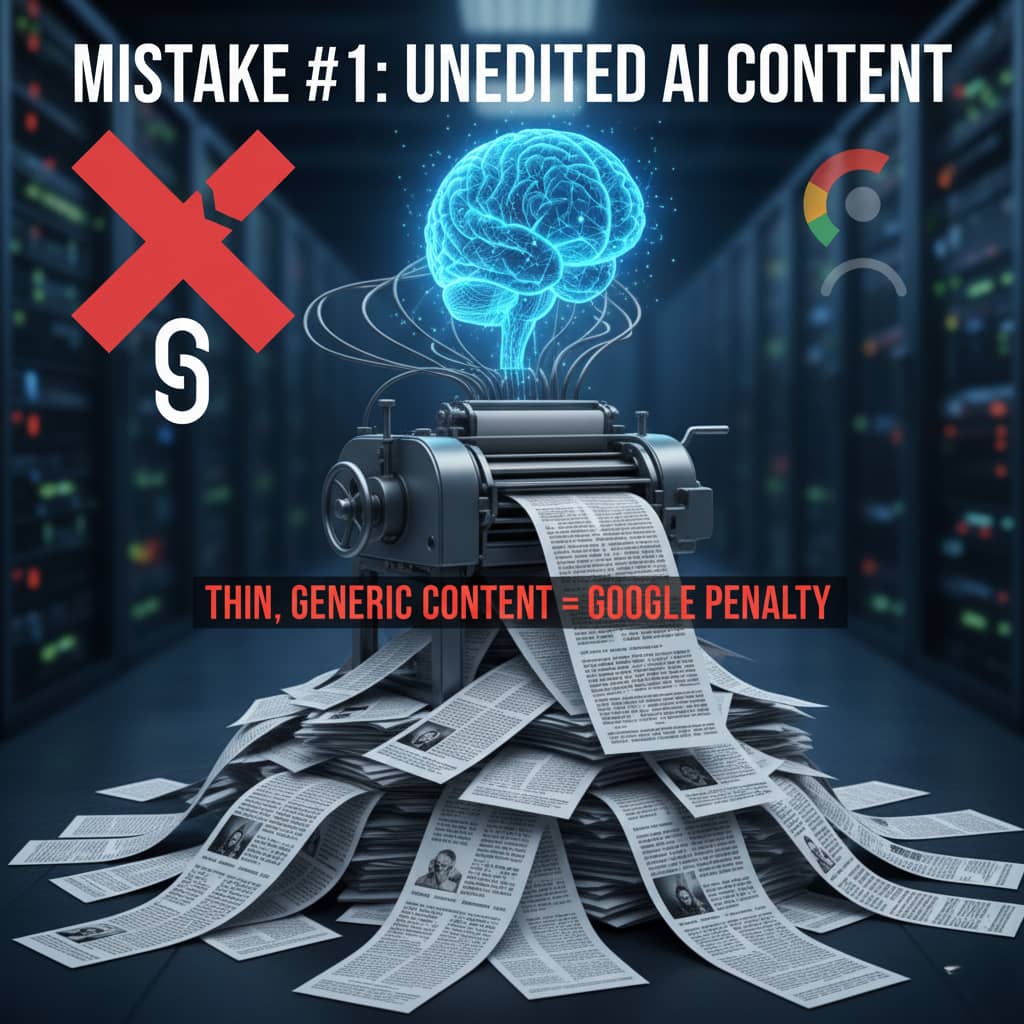
Mistake #1: Publishing AI-Generated Content Without Human Editing
The Problem
Google's algorithms have become incredibly sophisticated at detecting purely AI-generated content that lacks genuine expertise and human insight. When you publish raw AI output without editing, you're creating thin, generic content that fails to meet Google's E-E-A-T guidelines (Experience, Expertise, Authoritativeness, and Trustfulness).
Why This Kills Your Traffic
Search engines prioritize content that demonstrates real experience and unique perspectives. AI-generated text often contains:
- Generic statements that appear across thousands of websites
- Lack of specific examples or case studies
- No personal insights or expert opinions
- Repetitive phrasing and predictable structure
- Factual inaccuracies or outdated information
The Fix
Implement the 70-30 Rule
- Add personal experience: Include real examples from your work or industry
- Insert expert insights: Add your professional opinion and predictions
- Verify all facts: Cross-check statistics, dates, and claims
- Rewrite key sections: Ensure your introduction and conclusion are 100% original
- Include multimedia: Add custom images, screenshots, or videos
- Update with current data: Replace generic information with recent statistics
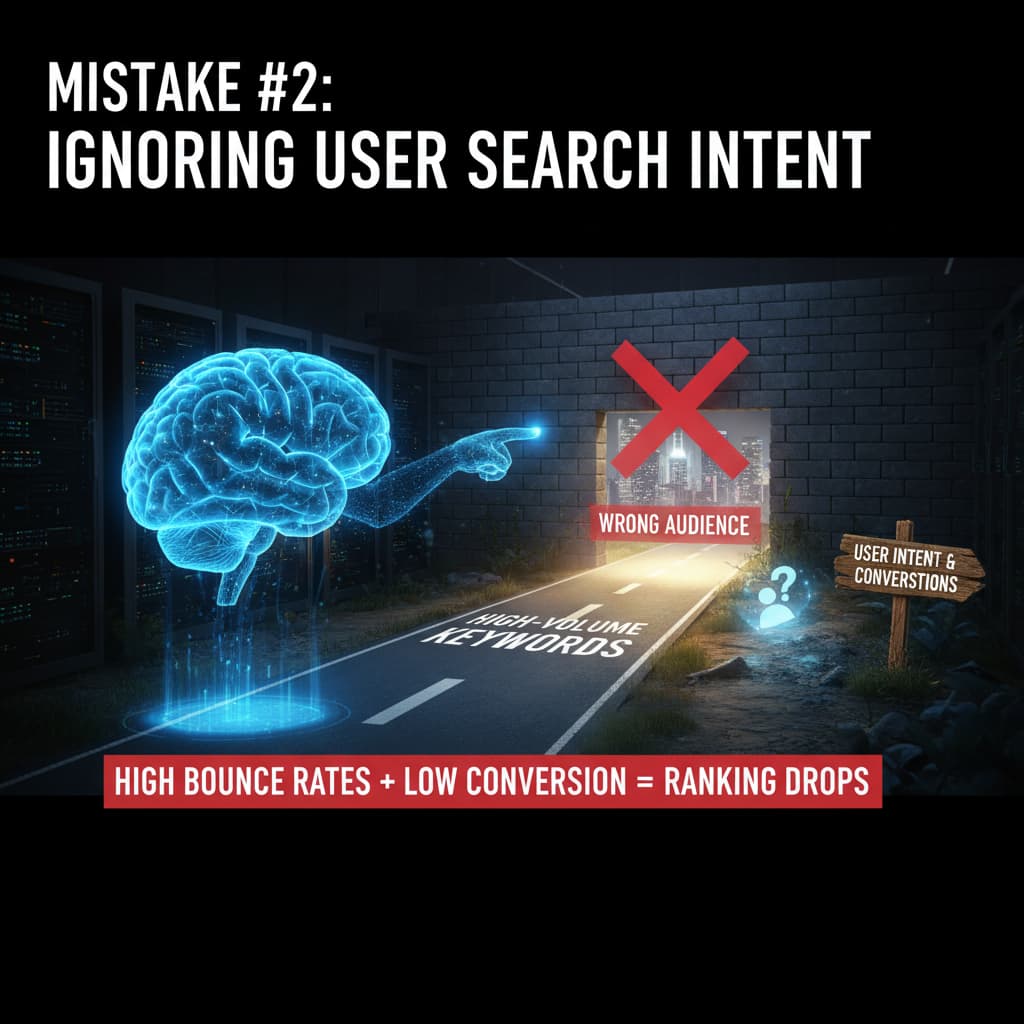
Mistake #2: Ignoring User Search Intent in AI Keyword Research
The Problem
AI tools excel at identifying high-volume keywords, but they often miss the crucial element of search intent. You might rank for keywords that bring the wrong audience or fail to address what users actually want to find.
Why This Kills Your Traffic
Ranking for irrelevant keywords leads to:
- High bounce rates (users leave immediately)
- Low engagement metrics
- Poor conversion rates
- Google recognizing your content doesn't satisfy user needs
- Eventual ranking drops as the algorithm adjusts
The Fix
Match AI keyword suggestions to the four search intent types:
1.Informational Intent ("how to use AI for SEO")
- Create comprehensive guides and tutorials
- Focus on education, not selling
2.Navigational Intent ("ChatGPT login")
- Optimize for brand-specific searches
- Ensure clear navigation paths
3.Commercial Intent ("best AI SEO tools")
- Write comparison and review content
- Include pros, cons, and honest assessments
4.Transactional Intent ("buy SEO software")
- Create product pages with clear CTAs
- Focus on conversion optimization
Action Steps:
- Manually review the top 10 search results for your target keyword
- Analyze what format dominates (listicles, how-tos, product pages)
- Note the common questions being answered
- Structure your AI content to match successful patterns
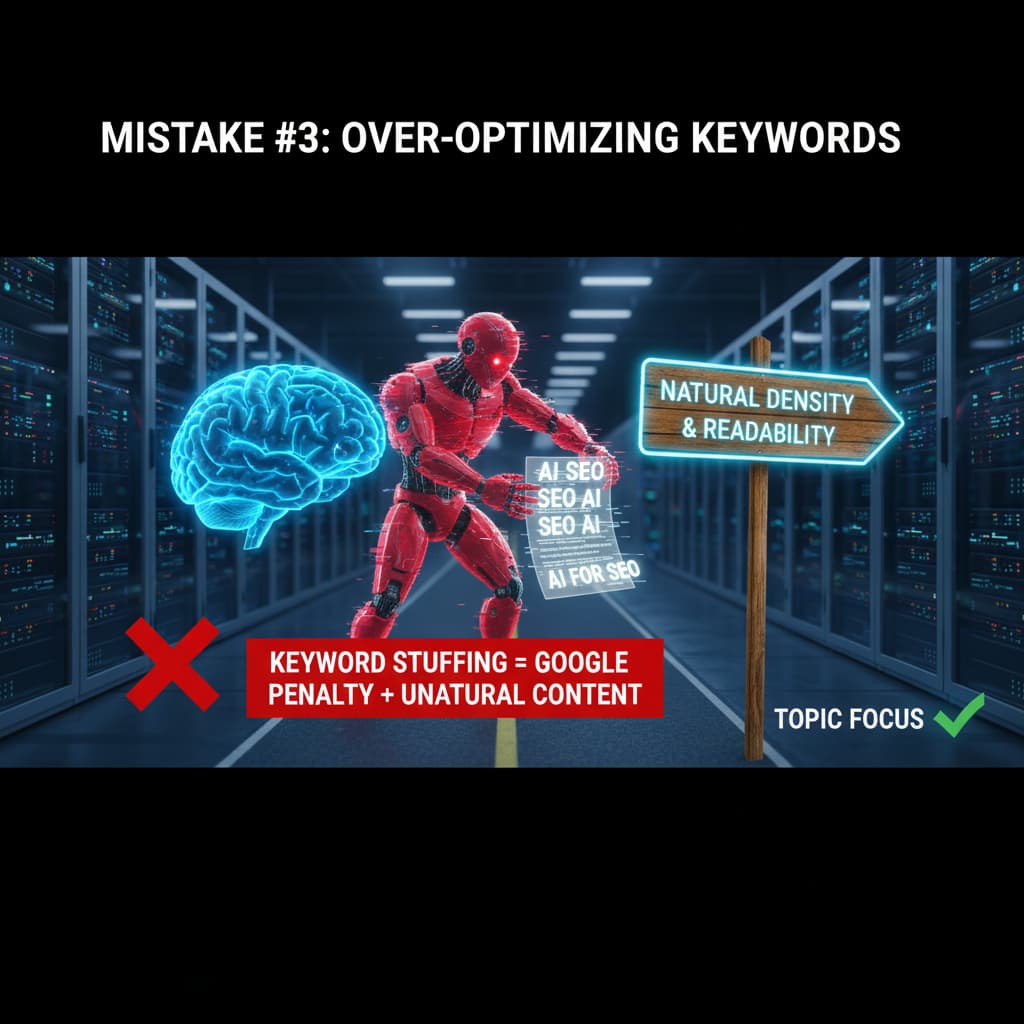
Mistake #3: Over-Optimizing With AI-Suggested Keywords
The Problem
AI SEO tools can analyze thousands of keyword variations and suggest aggressive optimization strategies. Many marketers make the mistake of cramming too many keywords into their content, creating an unnatural reading experience that both users and search engines dislike
Why This Kills Your Traffic
Keyword stuffing in 2025 results in:
- Google penalties for manipulation
- Reduced readability and user experience
- Lower dwell time (people leave quickly)
- Decreased trust and credibility
- Potential manual actions from Google's spam team
The Fix
Follow the Natural Density Approach:
- Primary keyword: Use 3-5 times in a 1,500-word article (0.3-0.5% density)
- Secondary keywords: Sprinkle naturally, 2-3 times each
- LSI keywords: Include related terms organically within context
- Focus on topics, not terms: Write for humans first, optimize second
Strategic Placement (Without Overdoing It):
- One instance in your H1 title
- One instance in your introduction (first 100 words)
- One instance in a subheading (H2 or H3)
- One instance in your conclusion
- Remaining uses distributed naturally throughout
The Read-Aloud Test:
Before publishing, read your content aloud. If keyword placement sounds awkward or repetitive, reduce the frequency.
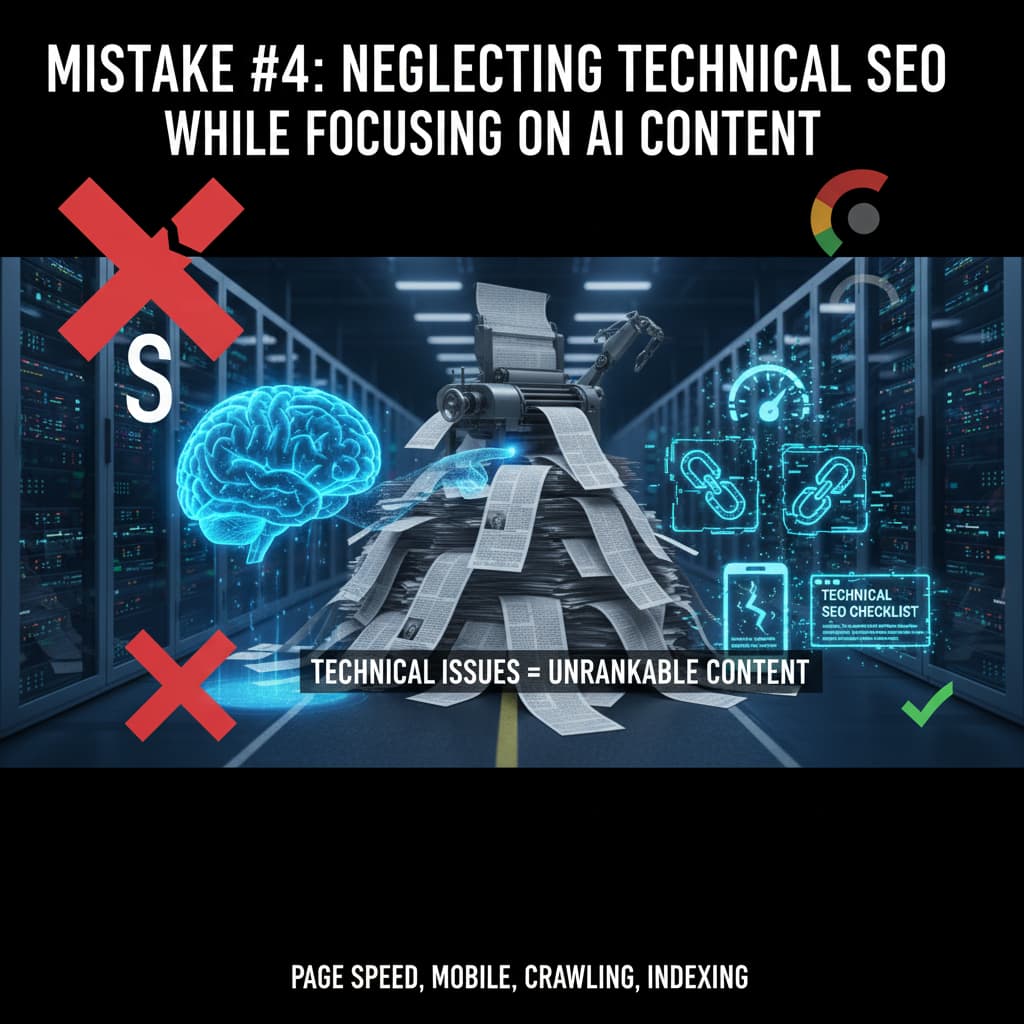
Mistake #4: Neglecting Technical SEO While Focusing on AI Content
The Problem
The excitement around AI content generation has led many marketers to pump out dozens of articles while completely ignoring the technical foundation that makes content discoverable. You can have the best AI-written content in the world, but if search engines can't crawl, index, or understand it properly, you'll never rank.
Why This Kills Your Traffic
Technical issues create barriers that prevent your content from ever reaching users:
- Slow page load times (Core Web Vitals failures)
- Poor mobile optimization
- Broken internal links in bulk-published content
- Duplicate content from similar AI outputs
- Missing or poorly formatted schema markup
- Crawl budget waste on low-value pages
The Fix
Implement a Technical SEO Checklist Before Scaling AI Content:
Page Speed Optimization:
- Compress AI-generated images before uploading
- Enable browser caching
- Use a content delivery network (CDN)
- Minimize JavaScript and CSS
- Target Core Web Vitals scores: LCP under 2.5s, FID under 100ms, CLS under 0.1
Mobile-First Approach:
- Test every AI-generated page on mobile devices
- Ensure readable font sizes (minimum 16px)
- Check that buttons and links are easily tappable
- Verify responsive images scale properly
Content Structure:
- Use proper heading hierarchy (H1 → H2 → H3)
- Implement schema markup (Article, FAQ, HowTo)
- Create XML sitemaps for new content
- Set up proper canonical tags
- Fix all broken internal and external links
Indexation Management:
- Use robots.txt to prevent indexing of low-value pages
- Submit new content to Google Search Console
- Monitor index coverage reports weekly
- Identify and fix crawl errors promptly
Pro Tip:
Before launching an AI content campaign, run a technical SEO audit using tools like Screaming Frog, Semrush, or Ahrefs to establish a healthy baseline.
Mistake #5: Creating AI Content Silos Without Internal Linking Strategy
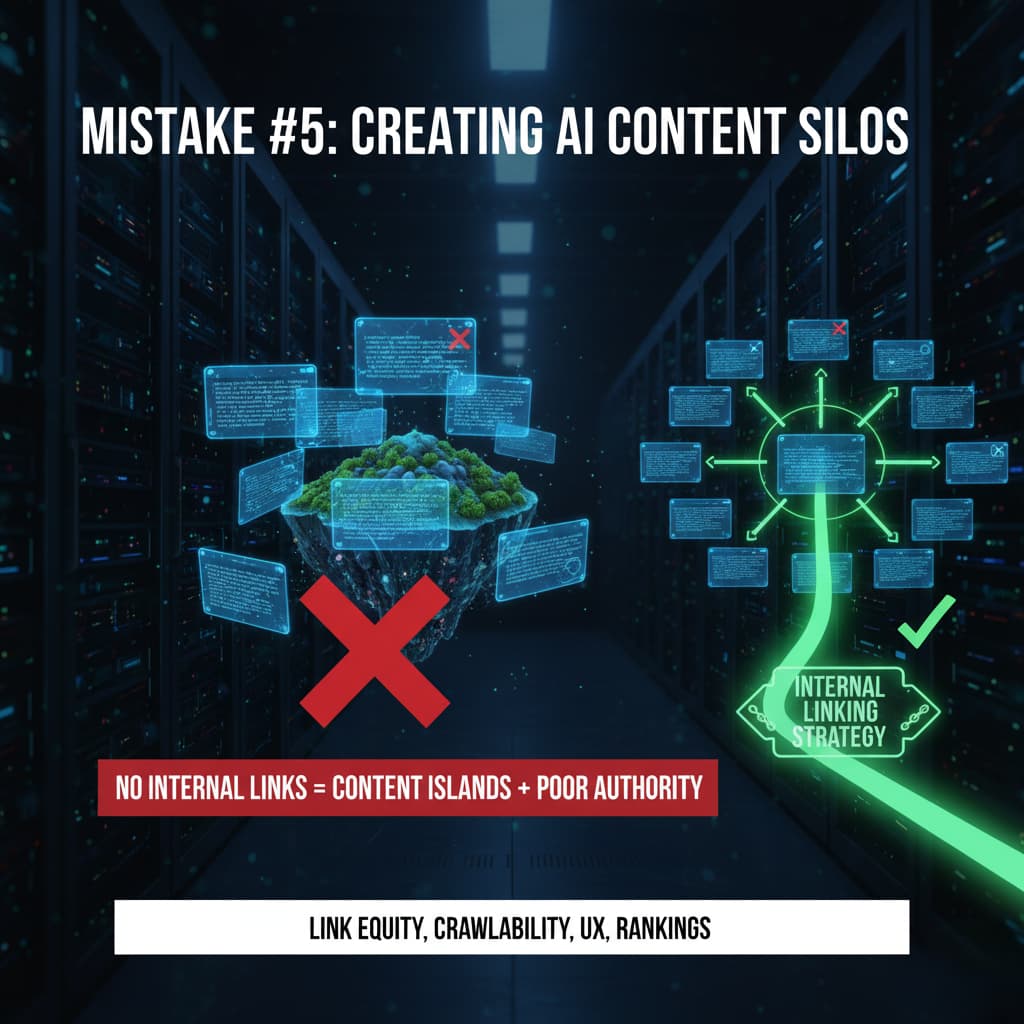
The Problem
When you use AI to rapidly generate multiple articles, it's easy to create isolated content pieces that don't connect to your existing website structure. This creates "content islands" that search engines struggle to understand in context of your overall site authority.
Why This Kills Your Traffic
Poor internal linking structure results in:
- Link equity (PageRank) not flowing through your site
- Search engines unable to understand content relationships
- Lower authority signals for individual pages
- Reduced crawl efficiency
- Users unable to discover related content
- Decreased time on site and pages per session
The Fix
Build a Strategic Internal Linking Framework:
The Hub and Spoke Model:
- Create pillar content: Comprehensive guides on core topics (3,000+ words)
- Develop cluster content: AI-generated articles on specific subtopics (1,500+ words)
- Link clusters to pillars: Every cluster article links back to its pillar page
- Link pillars together: Connect related pillar pages to show topical authority
- Use contextual anchor text: Descriptive phrases, not generic “click here”
Internal Linking Best Practices:
- Add 3-5 internal links per AI-generated article
- Link to both newer and established content
- Prioritize links to high-converting pages
- Use natural, keyword-rich anchor text
- Regularly update old content with links to new articles
- Check for broken internal links monthly
Content Cluster Example for "AI SEO":
Pillar Page:
"The Complete Guide to AI SEO" (links to everything below)
- Cluster 1: “AI Keyword Research Tools: A Comprehensive Review”
- Cluster 2: “How to Write AI Content That Ranks”
- Cluster 3: “AI SEO vs Traditional SEO: Pros and Cons”
- Cluster 4: “Measuring AI SEO Success: Key Metrics”
- Cluster 5: “AI SEO Case Studies: Real Results”
Each cluster links back to the pillar and to 2-3 related clusters, creating a strong topical authority network.
Automation Tip:
Use AI to suggest relevant internal linking opportunities by analyzing your existing content library and identifying semantic connections between articles.
How to Recover Traffic Lost to AI SEO Mistakes
Week 1: Audit and Identify
- Use Google Analytics to identify pages with traffic drops
- Run content quality assessments on AI-generated articles
- Check Google Search Console for manual actions or warnings
- Analyze Core Web Vitals and technical SEO issues
Week 2-3: Fix Critical Issues
- Rewrite or enhance the lowest-performing AI content
- Address all technical SEO problems (speed, mobile, indexation)
- Remove or consolidate thin content pages
- Fix broken links and redirect chains
Week 4-6: Enhance and Optimize
- Add expert insights and personal experiences to AI content
- Implement proper internal linking structure
- Update metadata and optimize for search intent
- Add multimedia elements (images, videos, infographics)
Week 7-8: Monitor and Adjust
- Track ranking changes in Google Search Console
- Monitor traffic patterns in Google Analytics
- Adjust strategy based on performance data
Realistic Expectations:
Traffic recovery typically takes 4–12 weeks depending on issue severity and site authority. Focus on sustainable improvements rather than quick fixes.
The Right Way to Use AI for SEO in 2025
Smart AI SEO Workflow:
1. Research Phase (AI-Powered)
- Use AI for keyword research and competitor analysis
- Identify content gaps in your niche
- Analyze SERP features and ranking patterns
- Generate content outlines and structure
2. Creation Phase (AI-Assisted, Human-Led)
- Generate first drafts with AI
- Add personal expertise and insights
- Include real examples and case studies
- Verify facts and update with current data
- Optimize for readability and user experience
3. Optimization Phase (AI-Enhanced)
- Use AI to suggest metadata improvements
- Analyze content for topical completeness
- Identify internal linking opportunities
- Generate schema markup code
4. Monitoring Phase (AI-Automated)
- Set up automated ranking tracking
- Monitor traffic patterns and anomalies
- Identify refresh opportunities
Tools That Won’t Get You Penalized:
For Content Creation:
- Claude, ChatGPT, Gemini (with human editing)
- Jasper AI, Copy.ai (for drafts)
- Grammarly (for readability enhancement)
For SEO Analysis:
- Surfer SEO, Clearscope, Frase, MarketMuse
For Technical SEO:
- Screaming Frog, GSC, PageSpeed Insights, Ahrefs, Semrush
Conclusion: Balance AI Efficiency With Human Expertise
AI SEO tools offer incredible efficiency, but they’re not a replacement for human expertise. The winning sites in 2025 combine AI precision with human insight.
Your Action Plan Starting Today:
- Audit existing AI-generated content for the five common mistakes
- Implement fixes systematically on high-traffic pages
- Establish editorial checks before publishing
- Commit to the 70–30 rule: AI draft, human enhancement
Stop the traffic bleeding today by fixing these issues — and you’ll position your site to dominate search results in the AI-powered SEO future.